Wednesday, September 30, 2015

Edgar Allan Poe's "Ligeia"

This post contains spoilers.

A few weeks ago, I finished reading a collection of Edgar Allan Poe works.  When I read "Ligeia" in March, this sentence caught my attention:
Or, perhaps, I cannot now bring these points [the circumstances under which the narrator met Ligeia] to mind, because, in truth, the character of my beloved, her rare learning, her singular yet placid cast of beauty, and the thrilling and enthralling eloquence of her low musical language, made their way into my heart by paces so steadily and stealthily progressive, that they have been unnoticed and unknown.
At the time, I just noticed that a few of the phrases sound and look similar:  "thrilling and enthralling," "steadily and stealthily," and "unnoticed and unknown."  About two weeks later, I thought of a way that they fit with the plot of the story.  I recently re-reading it so I could write this post.

At the end of the story, after Rowena - the narrator's second wife - dies, she comes to life again but looks like and apparently has become Ligeia.  So those similar-sounding and similar-looking phrases from early in the story (it's the third sentence) act - in some ways - as an element of foreshadowing.  As Rowena's body is transformed into Ligeia's, so does "thrilling" change into "enthralling," "steadily" into "stealthily," and "unnoticed" into "unknown."  The words don't undergo as perfect a change as the body, but if they did, the same word would just appear twice.

Re-reading the story, I found a few other instances of foreshadowing.  While the narrator is describing Ligeia's eyes (which eventually prove to be the attribute that convinces him that Rowena's body has become Ligeia's), he compares the feeling he gets from them to "one or two stars in heaven... [that are] double and changeable."  When Ligeia falls ill, her eyes "blazed with a too - too glorious effulgence."  As she's dying, the narrator is "entranced to a melody more than mortal - to assumptions and aspirations which mortality had never before known."  Each of these descriptions foreshadows the later transformation.  There's the narrator's inconsistent count ("one or two") of the "double and changeable stars," the double "too" - also a homophone for two, and an-other pair of similar-sounding and similar-looking words: "assumptions and aspirations."

It's very subtle foreshadowing that doesn't become apparent until re-reading the story with the knowledge that Ligeia reappears at the end, but with that knowledge, the phrases that describe doubles and changing become more significant and more meaningful.

Wednesday, September 23, 2015

The Chronicles of Narnia: The Magician's Nephew

I just wrote a short post about The Chronicles of Narnia: The Magician's Nephew, but - as it usually happens - after I posted it, I found something else I could have added.

Last July I started reading the whole Bible.  I'm only in Job so far, but I recently read something about Creation that seems to be an-other one of the Biblical parallels in the founding of Narnia that I wrote about last year.  God asks Job where he (Job) was when the earth was created:
"Where were you when I laid the foundation of the earth?  Tell me, if you have understanding.  Who determined its measurements - surely you know!  Or who stretched the line upon it?  On what were its bases sunk, or who laid its cornerstone, when the morning stars sang together and all the sons of God shouted for joy?"  (Job 38:4-7)
Because I'd just read The Magician's Nephew, "the morning stars [singing] together" sounded really familiar.  In Chapter Eight, the whole company of characters are standing in darkness when they start to hear singing.
Then two wonders happened at the same moment.  One was that the voice was suddenly joined by the other voices; more voices than you could possibly count.  They were in harmony with it, but far higher up the scale:  cold, tingling, silvery voices.  The second wonder was that the blackness overhead, all at once, was blazing with stars.  ...  The new stars and the new voices began at exactly the same time.  If you had seen and heard it, as Digory did, you would have felt quite certain that it was the stars themselves which were singing, and that it was the First Voice, the deep one, which had made them appear and made them sing.
I'm not sure if the stars' singing is meant to be a reference to that passage in Job, but since the founding of Narnia has connections to the Creation account in Genesis and since that Job passage also deals with Creation, I think there's something to it.

Wednesday, September 16, 2015

The Chronicles of Narnia: The Magician's Nephew

I recently started re-reading The Chronicles of Narnia books (I read them all around this time last year).

In Chapter Five of The Magician's Nephew, the Queen explains The Deplorable Word to Digory and Polly:  "It had long been known to the great kings of our race that there was a word which, if spoken with the proper ceremonies, would destroy all living things except the one who spoke it."

I didn't realize this the first time I read that part (because The Deplorable Word comes first), but The Deplorable Word is sort of the opposite of what Aslan does in Chapters Eight and Nine.  He sings Narnia into existence:
When a line of dark firs sprang up on a ridge about a hundred yards away she [Polly] felt that they were connected with a series of deep, prolonged notes which the Lion had sung a second before.  And when he burst into a rapid series of lighter notes she was not surprised to see primroses suddenly appearing in every direction.  Thus, with an unspeakable thrill, she felt quite certain that all the things were coming (as she said) "out of the Lion's head".  When you listened to his song you heard the things he was making up: when you looked around you, you saw them.
Where Aslan's singing brings things into life and existence, the Queen's Deplorable Word "destroy[s] all living things."

Wednesday, September 9, 2015

Les Misérables (Part I, Book Seven, Chapter 11)

This post contains spoilers.

In reading Les Misérables, I recently got to the courtroom scene where Monsieur Madeleine reveals his true identity as Jean Valjean.  He does this to protect Champmathieu, who was thought to be Jean Valjean and who was going to be sent to the galleys for life.  In the preceding chapters, it was explained that Champmathieu allegedly stole a branch of apples.  The particular object of his alleged theft got me thinking about religious parallels here, and in Chapter 11 ("Champmathieu More and More Astonished"), I found many of them.

First, from the previous chapters, Champmathieu's alleged theft of apples is a parallel to Adam and Eve's taking the forbidden fruit from the tree in the Garden of Eden (Genesis 3:6).  Jean Valjean intercedes for him, and in doing so, I found a lot of parallels between Valjean and Christ.  By correcting the misplacement of the identity, Valjean obviates the punishment that Champmathieu would have been faced with.  Similarly, Christ takes on humanity's punishment in the crucifixion.  To some degree, 1 Corinthians 15:22 demonstrates this parallelism and Christ as a second Adam:  "For as in Adam all die, so also in Christ shall all be made alive."

Chapter 11 itself starts with a description of Monsieur Madeleine (not yet revealed as Jean Valjean).  It's specifically noted that "his hair, already grey when he came to Arras, was now perfectly white."  There's a footnote in my edition that explains that "To have hair turn white overnight from an emotional shock is a common melodramatic device in nineteenth-century fiction."  I suppose "emotional shock" is a valid reading, but if Valjean is Christ-like in his intercession, that whiteness demonstrates purity and even the Transfiguration.  Later in the chapter, the narrator says, "Nobody said to himself that he there beheld the effulgence of a great light, yet all felt dazzled at heart."  The revelation of Valjean's identity is also called a "luminous fact."  This isn't too different from "And he was transfigured before them, and his face shone like the sun, and his clothes became white as light" (Matthew 17:2).  Valjean reveals his identity before Brevet, Chenildieu, and Cochepaille, three of his former galley-mates, and Christ's identity as true God at His Transfiguration is revealed before Peter, James, and John, three of his disciples.  After Valjean provides some details about some suspenders that Brevet owned in the galley, Brevet is "struck with surprise" and "gazed wildly at him" - a reaction that isn't too dissimilar from the disciples:  "When the disciples heard this ["This is my beloved Son"], they fell on their faces and were terrified" (Matthew 17:6).

Immediately after Valjean reveals his identity, "That species of religious awe was felt in the hall," and as he leaves the courtroom, "there was at this moment an indescribable divinity within him."  Like the Transfiguration, there are features that indicate a deity.

When an attorney calls for a doctor, thinking Monsieur Madeleine has gone mad, Valjean interrupts him "with a tone full of gentleness and authority" - more Christ-like attributes.  Valjean also says, "I tell you the truth," which Christ frequently says in the Gospels.

Finally, while Valjean's intercession for Champmathieu could be read as Christ's intercession for Adam (and for humanity as a whole), there are also parallels to Christ's trial before His crucifixion.  There's the obvious similarity that both are trials, but more specifically there's the crowd's choice to release Barabbas instead Christ where here Valjean acts to release Champmathieu and offers himself instead.  There are slight differences, since Christ didn't act to release Barabbas and Valjean is actually guilty, but the decisions of each that lead to the courtroom scenes are similar.  Before being turned over in the Garden of Gethsemane, Jesus prays, "If it be possible, let this cup pass from me; nevertheless, not as I will, but as you will" (Matthew 26:39).  Valjean goes through his own version of this, asking himself what is the right thing to do and pondering over it for multiple chapters.  But he too does as God wills (or as he thinks God wills) and gives himself up.

At the end of the chapter, Champmathieu is released from all accusations, because even though Valjean thinks Champmathieu is guilty (in his lengthy considerations in Book Seven, Chapter 2, he tells himself, "He has stolen!  it is useless for me to say he has not stolen, he has stolen!"), he still interceded for him.

---

After writing the original draft of this post, I found in later chapters some parallels that are more crucifixion-centered.  At the beginning of Chapter 5 in Book Eight, the narrator describes the reaction that the citizens of M--- sur M--- have after Monsieur Madeleine is revealed to have been Jean Valjean the galley slave.  "We are sorry not to be able to disguise the fact that, on this single sentence, he was a galley slave, almost everybody abandoned him.  ...  Three or four persons alone in the whole city remained faithful to his memory."  This is similar to Christ's disciples' falling away after His arrest in the Garden of Gethsemane:  "Then all the disciples left him and fled" (Matthew 26:56).

About a page later, Valjean escapes from prison and returns home.  The narrator explains that
It has never been known how he had succeeded in gaining entrance into the court-yard without opening the carriage port.  He had, and always carried about him, a pass-key which opened a little side door, but he must have been searched, and this taken from him.  This point is not yet cleared up.
This seems to have some connection to Christ's appearing to His disciples (after the resurrection) even though they were within a locked room.  "On the evening of that day, the first day of the week, the doors being locked where the disciples were for fear of the Jews, Jesus came and stood among them and said to them, 'Peace be with you'" - John 20:19.

I'm not sure if the Valjean-as-Christ parallels continue throughout the book (I guess I'll find out), but they do seem particularly strong in these chapters.

Wednesday, August 12, 2015

Les Misérables (Part I, Book Three, Chapter 9)

This post contains a minor spoiler.

The day after I posted about finding a reference to 1 Corinthians 13 in Les Misérables, I found an-other important Biblical reference.

Part I, Book Three is about Fantine, her three friends, and their lovers, rather than Jean Valjean.  Chapter 2 starts with "In this year, 1817, four young Parisians played 'a good joke.'"  The joke itself doesn't come until chapter 9.  Throughout Book Three, these four students have been telling their lovers that they have a surprise for them.  In chapter 9, after eating at a restaurant, they get up (ostensibly to go and get the surprise) and just leave the girls.  After a hour, the waiter gives them a letter (on which is written "THIS IS THE SURPRISE") that the students left for them.  It starts:
Oh, our lovers!
     Know that we have parents.  Parents - you scarcely know the meaning of the word, they are what are called fathers and mothers in the civil code, simple but honest.  Now these parents bemoan us, these old men claim us, these good men and women call us prodigal sons, desire our return and offer to kill for us the fatted calf.  We obey them, being virtuous.
The students want to portray themselves as honorable men who do what their parents want, and - in doing so - they compare themselves to (or say that their parents compare them to) the prodigal son.  But, instead, their comparison illustrates their complete ignorance of the prodigal son.

In the Parable of the Prodigal Son (Luke 15:11-32), a son asks his father for his share of the inheritance, goes off travelling, and "squander[s] his property in reckless living" (15:13).  A famine comes, leaving him even more desperate, so he gets a job feeding pigs (and finds himself envying even their food).  Then he realizes that his father's servants are treated better, so he goes back to his father's house, intending only to ask to be a servant and say "I am no longer worthy to be called your son" (15:19).  But, instead, his father welcomes him joyfully and commands his servants to "bring quickly the best robe, and put it on him, and put a ring on his hand, and shoes on his feet.  And bring the fattened calf and kill it, and let us eat and celebrate.  For this my son was dead, and is alive again; he was lost, and is found" (15:22-23).

The key difference between the actual prodigal son and the four students is that the prodigal son demonstrates penitence ("I will arise and go to my father, and I will say to him, 'Father, I have sinned against heaven and before you'" [15:18]) where the students pride themselves because they think themselves "virtuous."

There's also a difference in the incentive to return home.  The prodigal son returns merely so that he can find work and lodging, but the students' letter explains that the fatted calf is a reward that the parents are offering in exchange for their sons' homecoming.  The prodigal son wasn't expecting a feast upon his return, but the students seem almost weary of the prospect, as if it's an ordeal they have to go through.  If anything, they're like the prodigal son at the beginning of the parable, when he wants his share of the inheritance and is interested in "reckless living."

What struck me about the prodigal son comparison is its irony.  The students want to appear as if they're good sons and do what their parents want, but the actual prodigal son attained a much better understanding of his filial relationship.

Wednesday, August 5, 2015

Les Misérables (Part I, Book Two, Chapter 13)

About a month ago, I started re-reading Les Misérables (this is the second time I've read it).  I recently finished Book Two, and at the very end (in Chapter 13 - "Petit Gervais"), I think I found a reference to 1 Corinthians 13.

The narrator writes that Jean Valjean "beheld himself then, so to speak, face to face, and at the same time, through that hallucination, he saw, at a mysterious distance, a sort of light which he took at first to be a torch.  Examining more attentively this light which dawned upon his conscience, he recognised that it had a human form, and that this torch was the bishop."

The "face to face" part in particular is what reminded me of 1 Corinthians 13:12:  "For now we see in a mirror dimly, but then face to face.  Now I know in part; then I shall know fully, even as I have been fully known."  The study notes in my Bible gloss this passage, explaining that it's talking about the personal knowledge of God that the believer will have, but in Les Misérables, it seems to apply more to Jean Valjean's self-examination and his later certainty in what he has to do.  Shortly before his seeing himself face to face, the narrator asks:
Did a voice whisper in his ear that he had just passed through the decisive hour of his destiny, that there was no longer a middle course for him, that if, thereafter, he should not be the best of men, he would be the worst, that he must now, so to speak, mount higher than the bishop, or fall lower that the galley slave; that, if he would become good, he must become an angel; that, if he would remain wicked, he must become a monster?
These two passages are linked by the expression "so to speak."*  Of the two options presented, Valjean chooses to "mount higher than the bishop."  The chapter (and Book Two) ends with him "in the attitude of prayer, kneeling upon the pavement in the shadow, before the door of Monseigneur Bienvenu."

That higher path is characterized by the bishop bearing illumination, which is a similar description to what 1 Corinthians 13:12 has.  Things are no longer seen dimly, but with illumination ("The light grew brighter and brighter in [Valjean's] mind...").  The preceding verse seems to have some relation to Valjean's choice too:  "When I was a child, I spoke like a child, I thought like a child, I reasoned like a child.  When I became a man, I gave up childish ways" (1 Corinthians 13:11).  Valjean also seems to acquire a new perspective (he now "know[s] fully"):
His past life, his first offence, his long expiation, his brutal exterior, his hardened interior, his release made glad by so many schemes of vengeance, what had happened to him at the bishop's, his last action, this theft of forty sous from a child, a crime meaner and the more monstrous that it came after the bishop's pardon, all this returned and appeared to him, clearly, but in a light that he had never seen before.  He beheld his life, and it seemed to him horrible; his soul, and it seemed to him frightful.
At the end of the previous chapter (chapter 12 - "The Bishop at Work"), the bishop tells Jean Valjean that "It is your soul that I am buying for you.  I am withdrawing it from dark thoughts and from the spirit of perdition, and I am giving it to God!"  This dedication to God is an important part of the book, so it's fitting that Hugo's narrator uses Biblical descriptions like these from 1 Corinthians 13 to describe Valjean.

---
*Usually, I'd be hesitant to assert something about a translated work based on a particular phrase, but I checked an-other translation I have, and it too uses "so to speak" in both passages.

Wednesday, July 15, 2015

Odyssean Parallels in "The Robber and His Sons" from Grimm's Fairy Tales

I recently read Grimm's Fairy Tales, and in one of them - "The Robber and His Sons" - I found a lot of Odyssean parallels.  The titular robber's sons have been thrown in jail after stealing the Queen's horse, and the robber (who's reformed and had been against his sons' plot) tells the Queen three stories of his past life as a robber in order to free them.

The robber's first story is about his attempt to steal "an immense treasure of many thousand pieces of gold and silver" from a giant.  With his men, he goes to plunder the treasure, but the giant returns and catches them.  The robber and his hundred men are divided among ten of the giants so that there are groups of ten robbers for each giant.  The giant from whom they were trying to steal takes the robber and nine other men to a cave where he eats one a day.  The robber - as the thinnest of the ten - is left for last.  The robber notices that the giant has bad eyes, so he starts scheming.  He claims he is a physician and can help the giant.  Then he "put[s] oil in a vessel and mixed in with sulphur, pitch, salt, arsenic, and other destructive ingredients, and then I put it over the fire, as if I were preparing a plaster for his eyes."  The giant loses his sight from the robber's treatment and storms around his cave, striking the floor with a club.  The robber, however, is still trapped, as "the cave was everywhere surrounded with high walls, and the doors were closed with iron bolts."  The robber disguises himself as a ram among the giant's sheep, which works for awhile, but then the giant picks the fattest of his flock (the robber in disguise) to eat.  The robber jumps out of the giant's hand and eventually escapes, "shout[ing] in a mocking tone to him that I had escaped him in spite of all."

There are more than a few similarities between the robber's story and Odysseus' experience with the Cyclops in Book IX of The Odyssey.  [The following quotes are from E.V. Rieu's translation.]

While Odysseus and his men don't have the intention to steal from the Cyclops (Odysseus even prevents his men from taking the Cyclop's cheeses:  "I was not to be persuaded.  I wished to see the owner of the cave and had hopes of some friendly gifts from my host."), they do take "some cheeses just for ourselves" and eat them while waiting for the Cyclops to return from tending his flock.

When the Cyclops returns, he seals the cave with a stone.  "It was a mighty slab, such as you couldn't have budged from the ground, not with a score of heavy four-wheeled waggons to help you."  The Cyclops doesn't show hospitality to Odysseus and his men, rather he
seized a couple [of the men] and dashed their heads against the floor as though they had been puppies.  Their brains ran out of the ground and soaked the earth.  Limb by limb he tore them to pieces to make his meal, which he devoured like a mountain lion, never pausing till entrails and flesh, marrow and bones, where all consumed.
The next day, the Cyclops "once more seized upon two of us and prepared his supper."  But meanwhile, Odysseus has been scheming.  With his men, he's sharpened a piece of timber, "poked it into the blazing fire to make it hard," and plans to "lift the pole and twist it in the Cyclops' eye when he was sound asleep."  Odysseus encourages the Cyclops to drink some wine and tells him that his name is Nobody, to which the Cyclops replies, "Of all his company I will eat Nobody last, and the rest before him.  That shall be your gift."

Odysseus' plan works, and they skewer the Cyclops' eye.  "The fiery smoke from the blazing eyeball singed his lids and brow all round, and the very roots of his eye crackled in the heat."  After complaining to his friends that "Nobody's treachery... is doing me to death," the Cyclops opens the cave and plans to catch Odysseus and company as they run out.  Odysseus ties each of his men beneath three sheep, but he hides himself under a single ram.  The Cyclops doesn't notice the men beneath the sheep, but he becomes suspicious about the ram, asking "Why are you the last of the flock to pass out of the cave, you who have never lagged behind the sheep?"  Eventually, he lets the ram go, and Odysseus frees himself and his men from their sheepy bonds.

Odysseus has to taunt the Cyclops though, even after his crew warn him not to.  While still in range of the Cyclops' hearing, Odysseus shouts back at him:  "Cyclops, if anyone ever asks you how you came by your unsightly blindness, tell him your eye was put out by Odysseus, Sacker of Cities, the son of Laertes, who lives in Ithaca."

Both stories involve an attempt at robbery, a giant, an almost-inescapable cave, the daily eating of the narrator's men (with the narrator saved for last), the putting out of an eye, hiding under a ram amid a flock of sheep, and a final taunting.  After each final taunting, the narrator is almost caught a second time.  In "The Robber and His Sons," the robber is given a ring that causes him to repeatedly say, "Here I am!" and in The Odyssey, Odysseus' shout gives the Cyclops a target to throw a rock at.

I think it's pretty clear that the story in "The Robber and His Sons" took at least a few elements from The Odyssey.

Wednesday, October 29, 2014

Creation Parallels in The Chronicles of Narnia: The Magician's Nephew

Last month, I started reading The Chronicles of Narnia (I have an edition where all seven books are printed in one volume).  While reading The Magician's Nephew, I found multiple parallels between the founding of Narnia and Creation.

Chapter Nine (titled The Founding of Narnia) starts with "The Lion was pacing to and fro about that empty land and singing his new song.  ...  And as he walked and sang, the valley grew green with grass."  Polly notices that there's a "connection between the music and the things that were happening" and that "when you listened to his song you heard the things he was making up: when you looked around you, you saw them."  The Lion's singing is similar to God's speaking at Creation.  The first six days of Creation start with "And God said," followed by the existence of whatever God called into being.

A few chapters later (in Chapter Twelve), Aslan (The Lion) gives a horse wings.  He then asks the horse whether it's good, to which the horse replies, "It is very good."  It's not as similar as the parallel between God's speaking and Aslan's singing to call their respective worlds into existence, but it does bear some resemblance to the repeated "And God saw that it was good" throughout the account of Creation.

In Chapter Eleven, after the creation of Narnia, Aslan tells the Cabby and his wife that "You shall rule and name all these creatures, and do justice among them, and protect them from their enemies when enemies arise."  Aslan gives them dominion over Narnia in the same way that God gave dominion over the Earth to man:  "Now out of the ground the Lord God had formed every beast of the field and every bird of the heavens and brought them to the man to see what he would call them.  And whatever the man called every living creature, that was its name" (Genesis 2:19).  Chapter Nine details how Aslan also brought forth creatures from the Earth:  "The humps moved and swelled till they burst, and the crumbled earth poured out of them, and from each hump there came out an animal," which is similar to God's forming the animals from "out of the ground."

Both accounts (Creation and the founding of Narnia) also contain the entrance of evil into the world.  In Chapter Eleven of The Magician's Nephew, Aslan declares that "before the new, clean world I gave you is seven hours old, a force of evil has already entered it; waked and brought hither by this son of Adam."  This parallels with the serpent's deception of Eve, which results in man's "knowing good and evil" (Genesis 3:22).  Aslan's calling Digory a "son of Adam" strengthens the Biblical connection.

Both entrances of evil are linked with a tree, although not in the same way.  In the Bible, the tree is what evil uses in order to enter the world; in The Magician's Nephew, the tree will provide the seed for an-other tree that Aslan will plant in Narnia so that it will be protected from the Witch, the representation of evil.  The trees function differently, but both are accompanied by temptation.  The serpent tells Eve that if she eats of the tree in the Garden of Eden, "your eyes will be opened, and you will be like God, knowing good and evil" (Genesis 3:5).  In Chapter Thirteen of The Magician's Nephew, the Witch tells Digory that if he eats the fruit of the tree within the gates, "you and I will both live for ever and be king and queen of this whole world."  This tree within the gates actually bears some resemblance to the second tree in the Garden of Eden - the tree of life, which would grant man life forever if he ate of it (Genesis 3:22).

I've only just started to really get into C.S. Lewis' works, so while I've recognized a lot of the Biblical parallels he includes in The Chronicles of Narnia, I don't really know why he includes so many.

Wednesday, October 22, 2014

The Apple in Kafka's "The Metamorphosis"

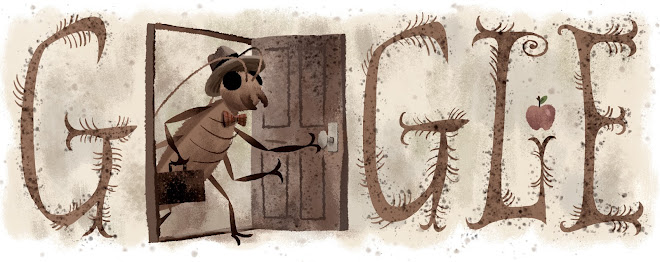
For Franz Kafka's 130th birthday on 3 July 2013, the Google Doodle was a scene from "The Metamorphosis."


I was really excited that they included the apple, and then I started thinking about what rôle the apple has in the story.  Last month, I finally re-read "The Metamorphosis" to see if the apple could represent original sin.  The edition of "The Metamorphosis" that I have includes critical essays, which helped a bit in determining whether my view was a valid one (my view certainly isn't as far-fetched as some).  I think I've come to the conclusion that the apple could represent original sin, but only narrowly, as other elements of the story don't have the same religious context.

Like original sin is inherited from one's parents after Eve took the fruit from the tree, Gregor is pummeled with apples by his father.  My edition notes the "religious connotation of [Kafka's] images," which includes the apple.  The explanatory notes in my edition confirm this connection between the apples and the tree (and between the tree and sin), adding that - unlike Eve - Gregor does not reach out for the fruit, but it is forced upon him.  The story also mentions debts that the father has that Gregor has to pay.  In some ways, this financial debt could be seen as a sort of moral deficiency.  The explanatory notes remark that "the debt that Gregor assumed for his parents and must pay resembles original sin."  Furthermore, Gregor's metamorphosis into a bug sort of reflects his fallen state.  As the introduction in my edition states, as a bug Gregor is "without a place in God's order."

As a whole, I don't think the story works as a religious allegory (if it were meant to be allegorical, I think there would be some salvation for Gregor that would restore him to his human form), but the image of the apple certainly works within that religious context.

Wednesday, October 15, 2014

"Fustian" in Catch-22

If I run across a word that I don't know while I'm reading a book, I generally look up the definition.  This is why I looked up fustian when I ran across it in chapter twenty-four of Catch-22 last month.  According to Merriam-Webster, fustian means "a strong cotton and linen fabric" or "high-flown or affected writing or speech."  I was really glad I looked up the definition because I think fustian is a key word in the sentence in which it appears:  "Yossarian was unmoved by the fustian charade of the burial ceremony, and by Milo's crushing bereavement."  For some context: Yossarian is sitting in a tree watching a funeral while Milo is complaining to him that no one is buying his Egyptian cotton.  Milo does notice the funeral and even comments on it, but he seems more concerned about his cotton:
"That's terrible," Milo grieved, and his large brown eyes filled with tears.  "That poor kid.  It really is terrible."  He bit his trembling lip hard, and his voice rose with emotion when he continued.  "And it will get even worse if the mess halls don't agree to buy my cotton."
A lot of things in the book are inverted like this or don't make sense in some other way, and I think fustian indicates that here.  Both of its meanings are applicable: it could apply to the funeral in the sense of "high-flown or affected writing or speech," and it could apply to Milo's predicament with his Egyptian cotton in the sense of "a strong cotton and linen fabric."  So the sentence could be re-written as "Yossarian was unmoved by the crushing bereavement of the burial ceremony, and by Milo's fustian charade" and still make sense.  In fact, it might make more sense that way.

While it's not related to fustian, I found something else interesting while reading Catch-22.  In chapter thirty-nine (subtitled "The Eternal City," one of the few subtitles that isn't a person), there's this sentence: "Buildings and featureless shapes flowed by him [Yossarian] noiselessly as though borne past immutably on the surface of some rank and timeless tide."  I couldn't help but notice the similarities between this sentence and the last sentence of Fitzgerald's The Great Gatsby:  "So we beat on, boats against the current, borne back ceaselessly into the past."  Although the movements they describe seem to be opposite, there are structural similarities between Heller's "borne past immutably" and Fitzgerald's "borne back ceaselessly," and both sentences mention time and contain nautical imagery.  Both seem to describe a sort of desolation and helplessness too.