Last month, I started reading The Chronicles of Narnia (I have an edition where all seven books are printed in one volume). While reading The Magician's Nephew, I found multiple parallels between the founding of Narnia and Creation.
Chapter Nine (titled The Founding of Narnia) starts with "The Lion was pacing to and fro about that empty land and singing his new song. ... And as he walked and sang, the valley grew green with grass." Polly notices that there's a "connection between the music and the things that were happening" and that "when you listened to his song you heard the things he was making up: when you looked around you, you saw them." The Lion's singing is similar to God's speaking at Creation. The first six days of Creation start with "And God said," followed by the existence of whatever God called into being.
A few chapters later (in Chapter Twelve), Aslan (The Lion) gives a horse wings. He then asks the horse whether it's good, to which the horse replies, "It is very good." It's not as similar as the parallel between God's speaking and Aslan's singing to call their respective worlds into existence, but it does bear some resemblance to the repeated "And God saw that it was good" throughout the account of Creation.
In Chapter Eleven, after the creation of Narnia, Aslan tells the Cabby and his wife that "You shall rule and name all these creatures, and do justice among them, and protect them from their enemies when enemies arise." Aslan gives them dominion over Narnia in the same way that God gave dominion over the Earth to man: "Now out of the ground the Lord God had formed every beast of the field and every bird of the heavens and brought them to the man to see what he would call them. And whatever the man called every living creature, that was its name" (Genesis 2:19). Chapter Nine details how Aslan also brought forth creatures from the Earth: "The humps moved and swelled till they burst, and the crumbled earth poured out of them, and from each hump there came out an animal," which is similar to God's forming the animals from "out of the ground."
Both accounts (Creation and the founding of Narnia) also contain the entrance of evil into the world. In Chapter Eleven of The Magician's Nephew, Aslan declares that "before the new, clean world I gave you is seven hours old, a force of evil has already entered it; waked and brought hither by this son of Adam." This parallels with the serpent's deception of Eve, which results in man's "knowing good and evil" (Genesis 3:22). Aslan's calling Digory a "son of Adam" strengthens the Biblical connection.
Both entrances of evil are linked with a tree, although not in the same way. In the Bible, the tree is what evil uses in order to enter the world; in The Magician's Nephew, the tree will provide the seed for an-other tree that Aslan will plant in Narnia so that it will be protected from the Witch, the representation of evil. The trees function differently, but both are accompanied by temptation. The serpent tells Eve that if she eats of the tree in the Garden of Eden, "your eyes will be opened, and you will be like God, knowing good and evil" (Genesis 3:5). In Chapter Thirteen of The Magician's Nephew, the Witch tells Digory that if he eats the fruit of the tree within the gates, "you and I will both live for ever and be king and queen of this whole world." This tree within the gates actually bears some resemblance to the second tree in the Garden of Eden - the tree of life, which would grant man life forever if he ate of it (Genesis 3:22).
I've only just started to really get into C.S. Lewis' works, so while I've recognized a lot of the Biblical parallels he includes in The Chronicles of Narnia, I don't really know why he includes so many.

"Yet all experience is an arch wherethrough / Gleams that untravelled world, whose margin fades / For ever and for ever when I move."
Wednesday, October 29, 2014
Wednesday, October 22, 2014
The Apple in Kafka's "The Metamorphosis"
For Franz Kafka's 130th birthday on 3 July 2013, the Google Doodle was a scene from "The Metamorphosis."
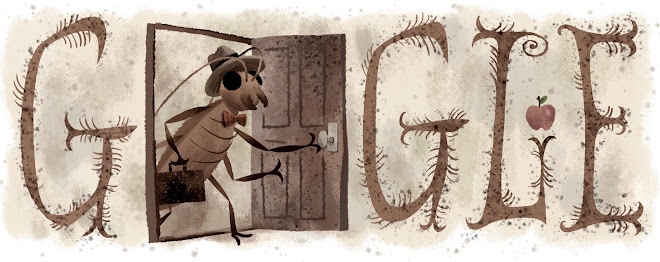
I was really excited that they included the apple, and then I started thinking about what rôle the apple has in the story. Last month, I finally re-read "The Metamorphosis" to see if the apple could represent original sin. The edition of "The Metamorphosis" that I have includes critical essays, which helped a bit in determining whether my view was a valid one (my view certainly isn't as far-fetched as some). I think I've come to the conclusion that the apple could represent original sin, but only narrowly, as other elements of the story don't have the same religious context.
Like original sin is inherited from one's parents after Eve took the fruit from the tree, Gregor is pummeled with apples by his father. My edition notes the "religious connotation of [Kafka's] images," which includes the apple. The explanatory notes in my edition confirm this connection between the apples and the tree (and between the tree and sin), adding that - unlike Eve - Gregor does not reach out for the fruit, but it is forced upon him. The story also mentions debts that the father has that Gregor has to pay. In some ways, this financial debt could be seen as a sort of moral deficiency. The explanatory notes remark that "the debt that Gregor assumed for his parents and must pay resembles original sin." Furthermore, Gregor's metamorphosis into a bug sort of reflects his fallen state. As the introduction in my edition states, as a bug Gregor is "without a place in God's order."
As a whole, I don't think the story works as a religious allegory (if it were meant to be allegorical, I think there would be some salvation for Gregor that would restore him to his human form), but the image of the apple certainly works within that religious context.

Wednesday, October 15, 2014
"Fustian" in Catch-22
If I run across a word that I don't know while I'm reading a book, I generally look up the definition. This is why I looked up fustian when I ran across it in chapter twenty-four of Catch-22 last month. According to Merriam-Webster, fustian means "a strong cotton and linen fabric" or "high-flown or affected writing or speech." I was really glad I looked up the definition because I think fustian is a key word in the sentence in which it appears: "Yossarian was unmoved by the fustian charade of the burial ceremony, and by Milo's crushing bereavement." For some context: Yossarian is sitting in a tree watching a funeral while Milo is complaining to him that no one is buying his Egyptian cotton. Milo does notice the funeral and even comments on it, but he seems more concerned about his cotton:
While it's not related to fustian, I found something else interesting while reading Catch-22. In chapter thirty-nine (subtitled "The Eternal City," one of the few subtitles that isn't a person), there's this sentence: "Buildings and featureless shapes flowed by him [Yossarian] noiselessly as though borne past immutably on the surface of some rank and timeless tide." I couldn't help but notice the similarities between this sentence and the last sentence of Fitzgerald's The Great Gatsby: "So we beat on, boats against the current, borne back ceaselessly into the past." Although the movements they describe seem to be opposite, there are structural similarities between Heller's "borne past immutably" and Fitzgerald's "borne back ceaselessly," and both sentences mention time and contain nautical imagery. Both seem to describe a sort of desolation and helplessness too.
"That's terrible," Milo grieved, and his large brown eyes filled with tears. "That poor kid. It really is terrible." He bit his trembling lip hard, and his voice rose with emotion when he continued. "And it will get even worse if the mess halls don't agree to buy my cotton."A lot of things in the book are inverted like this or don't make sense in some other way, and I think fustian indicates that here. Both of its meanings are applicable: it could apply to the funeral in the sense of "high-flown or affected writing or speech," and it could apply to Milo's predicament with his Egyptian cotton in the sense of "a strong cotton and linen fabric." So the sentence could be re-written as "Yossarian was unmoved by the crushing bereavement of the burial ceremony, and by Milo's fustian charade" and still make sense. In fact, it might make more sense that way.
While it's not related to fustian, I found something else interesting while reading Catch-22. In chapter thirty-nine (subtitled "The Eternal City," one of the few subtitles that isn't a person), there's this sentence: "Buildings and featureless shapes flowed by him [Yossarian] noiselessly as though borne past immutably on the surface of some rank and timeless tide." I couldn't help but notice the similarities between this sentence and the last sentence of Fitzgerald's The Great Gatsby: "So we beat on, boats against the current, borne back ceaselessly into the past." Although the movements they describe seem to be opposite, there are structural similarities between Heller's "borne past immutably" and Fitzgerald's "borne back ceaselessly," and both sentences mention time and contain nautical imagery. Both seem to describe a sort of desolation and helplessness too.
Wednesday, October 8, 2014
Seeming/Being in Hamlet
When I read Hamlet last month, I started finding some instances that involve the dichotomy of seeming and being that Hamlet mentions early in the play:
Seems, madam? Nay, it is. I know not "seems."Shortly after I started reading Hamlet, I also started Macbeth, and one of the essays in my edition (David Scott Kastan's "Words, Words, Words: Understanding Shakespeare's Language," which I think appears in all the Barnes & Noble editions of Shakespeare's plays) mentions this seeming/being dichotomy with regard to Claudius' announcement of his marriage to Gertrude:
'Tis not alone my inky cloak, good mother,
Nor customary suits of solemn black,
Nor windy suspiration of forced breathe,
No, nor the fruitful river in the eye,
Nor the dejected havior of the visage,
Together with all forms, moods, shapes of grief,
That can denote me truly. These indeed seem,
For they are actions that a man might play;
But I have that within which passeth show -
These but the trappings and the suits of woe (I.ii.81-91)
Sometimes it is not the network of imagery but the very syntax that speaks, as when Claudius announces his marriage to Hamlet's mother:While reading Hamlet, I found an-other instance of this - where the syntax of the sentence reveals more meaning than the words themselves. When Ophelia enters in Act II, Scene 1, she tells Polonius that she has been "so affrighted." When asked the cause, she explains that
Therefore our sometime sister, now our Queen,All he really wants to say here is that he has married Gertrude, his former sister-in-law: "Therefore our sometime sister... Have we... Taken to wife." But the straightforward sentence gets interrupted and complicated, revealing his own discomfort with the announcement. ... The very unnaturalness of the sentence is what alerts us that we are meant to understand more than the simple relation of fact.
Th' imperial jointress to this warlike state,
Have we--as 'twere with a defeated joy,
With an auspicious and a dropping eye,
With mirth in funeral and with dole in marriage,
In equal scale weighing delight and dole--
Taken to wife. (Hamlet, 1.2.8-14)
Lord Hamlet, with his doublet all unbraced,Ophelia does the same thing that Claudius does in the previous act. While Hamlet's appearance could very well contribute to Ophelia's fright of him, the only action in those seven lines is that "Lord Hamlet... comes before [her]." Again, the syntax illustrates more than just the words, and here, it indicates the seeming/being dichotomy that's so important in the play. Ophelia is putting more emphasis on what Hamlet looks like than on what he does. More emphasis on how he seems (by means of his appearance) than on what he is (indicated by his action). Interestingly, Hamlet himself points out this speaking syntax when he tells one of the actors to "Suit the action to the word, the word to the action" (III.ii.17-18).
No hat upon his head, his stockings fouled,
Ungart'red, and down-gyved to his ankle;
Pale as his shirt, his knees knocking each other,
And with a look so piteous in purport
As if he had been loosed out of hell
To speak of horrors--he comes before me. (II.i.87-93)
Before the play (the play within the play) starts, Hamlet shares his plan (observing Claudius' reaction to the play, which Hamlet has re-written to resemble Claudius' murdering King Hamlet) with Horatio, explaining that he will "rivet [his eyes] to [Claudius'] face, / And after [they] will both [their] judgments join / In censure of his seeming" (III.ii.86-88). In light of the seeming/being distinction, the word choice here seems important, but I don't quite know the whole implication. Part of it seems to be that characters base their actions (their being) on others' appearances (their seeming). Hamlet exhibits this with his watching Claudius' reaction just as Ophelia demonstrates this in her explanation of her fear at Hamlet's appearance. Still, I feel there's more to this that I'm not grasping.
Claudius is attentive to the seeming/being thing too. In Act IV, he questions Laertes' grief over Polonius death, wondering if it's genuine or not: "Laertes, was your father dear to you? / Or are you like the painting of a sorrow, / A face without a heart?" (IV.vii.120-122).
While it's not directly related to seeming or being (although "without [judgement] we are pictures of mere beasts" may relate), I found Claudius' lines in Act IV, Scene 5 really interesting. Ophelia, mentally unstable after her father's death, has just left the scene.
O, this is the poison of deep grief; it springsClaudius is doing two different things here, and I can't quite believe either. First, he's sympathizing for Ophelia and her unstable mental state because her father is dead, and yet Hamlet is in the same position without any of Claudius' good will. Maybe Claudius views King Hamlet's death and its effect on Hamlet differently than he does Polonius' death and its effect on Ophelia because he had a hand in King Hamlet's death. Still, it's almost literally incredible that he can't see how similar the situations are.
All from her father's death. O Gertrude, Gertrude,
When sorrows come, they come not single spies,
But in battalions! First, her father slain;
Next, your son gone, and he most violent author
Of his own just remove; the people muddied,
Thick and unwholesome in their thoughts and whispers
For good Polonius' death, and we have done but greenly
In hugger-mugger to inter him; poor Ophelia
Divided from herself and her fair judgment,
Without the which we are pictures of mere beasts;
Last, and as much containing as all these,
Her brother is in secret come from France;
Feeds on his wonder, keeps himself in clouds,
And wants not buzzers to infect his ear
With pestilent speeches of his father's death,
Wherein necessity, of matter beggared,
Will nothing stick our person to arraign
In ear and ear. O my dear Gertrude, this,
Like to a murd'ring piece, in many places
Gives me superfluous death. (IV.v.77-97)
Second, he seems to be making puns about how he killed King Hamlet. In Act I, Scene 5, the Ghost of King Hamlet explains that Claudius poured poison in his ear while he was sleeping in the orchard, which is how he died (I.v.66-82). And here in Act IV, Claudius mentions "poison," a "father's death," "want[ing] not buzzers to infect his ear / With petilen[ce]," "In ear and ear," and "murd'ring." He doesn't connect King Hamlet's death's effect on Hamlet with Polonius' death's effect on Ophelia, yet he seems to be remembering King Hamlet's death at the same time.
Wednesday, September 24, 2014
More on Brave New World
While re-reading Brave New World, I found a lot with regard to the Hamlet quotes, but I also noticed a lot of other stuff that I'd neglected the other times I'd read the book.
I'd never noticed how appropriate Mr. Foster's name is. In the book, children aren't really born; rather, they're "decanted." As such, they don't really have parents, so Mr. Foster, in working in the Hatchery, is sort of like a foster parent.
Around the same time that Mr. Foster is introduced in the book (chapter one), social predestination is mentioned. While the caste element of this predestination is encountered throughout the book, I think this early section is the only time that other physical conditioning is mentioned (at least at any length):
Reading the book this time, I realized more fully how disastrous this is. Not only is it messing around with biology and free will with (at best) questionable ethics, but it also totally disregards the possibility of new job positions or old jobs' becoming obsolete. If a new position requiring specific skills is spontaneously created, there won't be anyone with those skills, and there will be a period of about two decades before a group can be decanted and conditioned to qualify for that position. And if rockets are no longer being built, what are those two hundred and fifty rocket-plane engineers - already endowed with those specific skills and only those specific skills - going to do? In the one case, there's a deficit (or maybe even an impediment), and in the other, there's a surplus. Either would significantly affect the technological progress that's so important in the book.
I also noticed to a new degree how much religion has been eradicated. As the Director explains in chapter three, "All crosses had their tops cut and became T's," but this is also seen just in the word cross itself. Instead of Charing Cross Station, there's Charing-T Tower, which encapsulates not only the book's view of technological progress (what was a station has become a tower) but also this eradication of religion and some specific religious elements. Yet - interestingly - as an adjective (a synonym for angry), cross still exists. In chapter four, Lenina says, "Henry gets cross if I keep him waiting."
There's also a fair amount about delayed gratification that I hadn't noticed before. In chapter six, Bernard says, "I didn't want it to end with our going to bed... not at once, not the first day," and he says he wants "to try the effect of arresting my impulses." When John is introduced, he's shown to "arrest his impulses" without even thinking about it. In chapter seven when he sees Lenina, he "was so much overcome that he had to turn away and pretend to be looking very hard at something on the other side of the square." When John sees Lenina sleeping in the rest-house in the reservation, he even denounces his impulses:
Finally, I understood to a better degree John's inhabiting the lighthouse in the last chapter of the book. Not only is he trying to give himself some direction ("Oh, forgive me! Oh, make me pure! Oh, help me to be good!"), but he also wants to be an example to the rest of society. It's not explicitly mentioned in the book, but he does think "vindictively" that throwing away the enhanced food he's purchased will "teach them." In a way, the purer life that he endeavors to lead will be a beacon for everyone else, so it's fitting that he lives in a lighthouse.
I'd never noticed how appropriate Mr. Foster's name is. In the book, children aren't really born; rather, they're "decanted." As such, they don't really have parents, so Mr. Foster, in working in the Hatchery, is sort of like a foster parent.
Around the same time that Mr. Foster is introduced in the book (chapter one), social predestination is mentioned. While the caste element of this predestination is encountered throughout the book, I think this early section is the only time that other physical conditioning is mentioned (at least at any length):
On Rack 10 rows of next generation's chemical workers were being trained in the toleration of lead, caustic soda, tar, chlorine. The first batch of two hundred and fifty embryonic rocket-plane engineers was just passing the eleven hundred metre mark on Rack 3. A special mechanism kept their containers in constant rotation. "To improve their sense of balance," Mr. Foster explained, "Doing repairs on the outside of a rocket in mid-air is a ticklish job, We slacken off the circulation when they're right way up, so that they're half starved, and double the flow of surrogate when they're upside down. They learn to associate topsy-turvydom with well-being; in fact, they're only truly happy when they're standing in their heads."About a page earlier, heat conditioning is also mentioned, for those "predestined to emigrate to the tropics." As the Director of Hatcheries and Conditioning explains, "All conditioning aims at that: making people like their unescapable social destiny."
Reading the book this time, I realized more fully how disastrous this is. Not only is it messing around with biology and free will with (at best) questionable ethics, but it also totally disregards the possibility of new job positions or old jobs' becoming obsolete. If a new position requiring specific skills is spontaneously created, there won't be anyone with those skills, and there will be a period of about two decades before a group can be decanted and conditioned to qualify for that position. And if rockets are no longer being built, what are those two hundred and fifty rocket-plane engineers - already endowed with those specific skills and only those specific skills - going to do? In the one case, there's a deficit (or maybe even an impediment), and in the other, there's a surplus. Either would significantly affect the technological progress that's so important in the book.
I also noticed to a new degree how much religion has been eradicated. As the Director explains in chapter three, "All crosses had their tops cut and became T's," but this is also seen just in the word cross itself. Instead of Charing Cross Station, there's Charing-T Tower, which encapsulates not only the book's view of technological progress (what was a station has become a tower) but also this eradication of religion and some specific religious elements. Yet - interestingly - as an adjective (a synonym for angry), cross still exists. In chapter four, Lenina says, "Henry gets cross if I keep him waiting."
There's also a fair amount about delayed gratification that I hadn't noticed before. In chapter six, Bernard says, "I didn't want it to end with our going to bed... not at once, not the first day," and he says he wants "to try the effect of arresting my impulses." When John is introduced, he's shown to "arrest his impulses" without even thinking about it. In chapter seven when he sees Lenina, he "was so much overcome that he had to turn away and pretend to be looking very hard at something on the other side of the square." When John sees Lenina sleeping in the rest-house in the reservation, he even denounces his impulses:
He found himself reflecting that he had only to take hold of the zipper at her neck and give one long, strong pull... He shut his eyes, he shook his head. ... Detestable thought! He was ashamed of himself.Bernard seems helpless to "arrest his impulses," but John has no problem in doing so, not even daring to look at Lenina.
Finally, I understood to a better degree John's inhabiting the lighthouse in the last chapter of the book. Not only is he trying to give himself some direction ("Oh, forgive me! Oh, make me pure! Oh, help me to be good!"), but he also wants to be an example to the rest of society. It's not explicitly mentioned in the book, but he does think "vindictively" that throwing away the enhanced food he's purchased will "teach them." In a way, the purer life that he endeavors to lead will be a beacon for everyone else, so it's fitting that he lives in a lighthouse.
Wednesday, September 17, 2014
Hamlet in Brave New World
I recently re-read Brave New World. At the same time, I was also re-reading Hamlet (and I still am), so I discovered some connections between the two, specifically in how Huxley uses the original context of the Hamlet quotes to add some more depth to his characters.
This post contains spoilers for both Hamlet and Brave New World.
In Chapter 8 in the midst of John's history in the reservation, he acquires The Complete Works of William Shakespeare, which - in a way - give him the language to express his thoughts. At the same time, it's explained how he hates Popé, one of the Indians on the reservation with whom his mother Linda spends a lot of time. It's kind of hard to tell whether Shakespeare helps John in articulating his hate for Popé, or whether John starts hating Popé because of what he reads in Shakespeare and how similar it is to his own situation. In any case, his hating Popé is accompanied with two Shakespeare quotes:
The characters in Brave New World sort of match up to the rôles in Hamlet. John is Hamlet. His mother Linda is Gertrude. Popé is Claudius. But the rôle of King Hamlet could be fulfilled by either Thomas (the Director of Hatcheries and Conditioning), who is John's biological father, or - more broadly - the "civilized" society of England itself. (I think the broader application is more useful.) In both works, the son tries to kill his mother's new partner, and because Hamlet does this at the behest of the Ghost of King Hamlet, the parallels suggest that, in trying to kill Popé, John aligns himself with his father figure - England, including its "civilized" values of conformity and possibly even its caste system. In the reservation, John and Linda stick out, and through John's attempts to complete the Indians' rituals, it's obvious that he's trying to fit in. Before he sees England firsthand, he thinks it will provide him with that sense of belonging.
The parallels beyond that get sort of confusing, and they might even break down after that scene. Like Hamlet, John dies at the end, but where Hamlet is (at least relatively) successful in avenging his father by killing Claudius, John turns away from his father figure - the society that bred him. He doesn't have the strength to reform - or even resist - the "civilized" England and hangs himself. At the end of the book, when he's discovered dead, his feet "turned towards the right: north, north-east, east, south-east, south-south-west; then paused, and, after a few seconds, turned as unhurriedly back towards the left. South-south-west, south, south-east, east...." This is similar to Hamlet's "I am but mad north-north-west. When the wind is southerly I know a hawk from a handsaw" (II.ii.388-389), but I'm not sure of the depth of the resemblance. I don't think I can make a very strong case for the southerly direction that John's feet point for most of the description and their connection with Hamlet's ability to "know a hawk from a handsaw" (i.e. that John was the only sane person in a land of crazy people), but at the very least, John's feet's directions - combined with that Hamlet quote - illustrate the conflict within him - whether he would adopt the ways of "civilization" or renounce them. It could also represent the split nature of his being - his parents were from the "civilized" society yet he was raised as a "savage" in the reservation.
I think there's also a lot to be said between the two works about what's natural and what's artificial. The conditioning in Brave New World seems to have some precedent with the differentiation of "seems" and "is" in Hamlet, but I'd have to re-read both again in order to pay attention to those specific points. Additionally, in the same way that John can be cast as Hamlet, I think he bears some resemblance to Miranda from The Tempest (beyond just their shared excitement about a "brave new world"), but I think it's been two years since I last read The Tempest, so in order to support that claim I'd have to reacquaint myself with that too. Reading Brave New World this time, I was paying attention mostly to the characters' connections to Hamlet.
This post contains spoilers for both Hamlet and Brave New World.
In Chapter 8 in the midst of John's history in the reservation, he acquires The Complete Works of William Shakespeare, which - in a way - give him the language to express his thoughts. At the same time, it's explained how he hates Popé, one of the Indians on the reservation with whom his mother Linda spends a lot of time. It's kind of hard to tell whether Shakespeare helps John in articulating his hate for Popé, or whether John starts hating Popé because of what he reads in Shakespeare and how similar it is to his own situation. In any case, his hating Popé is accompanied with two Shakespeare quotes:
Nay, but to liveAnd, when John's thoughts turn to murdering Popé:
In the rank sweat of an enseamed bed,
Stew'd in corruption, honeying and making love
Over the nasty sty
When he is drunk asleep, or in his rageBoth of these are from Hamlet. The first ("Nay, but to live...") is in Act III, Scene IV (lines 103-106), when Hamlet talks to Gertrude about her marrying Claudius so soon after King Hamlet's death, and the second ("When he is drunk asleep...) is at the very end of Act III, Scene III (lines 92-93), when Hamlet resists killing Claudius because Claudius is praying (and Hamlet thinks that killing him in the midst of prayer will send him to Heaven, which Hamlet wants to avoid), so he thinks of better opportunities to kill him.
Or in the incestuous pleasure of his bed
The characters in Brave New World sort of match up to the rôles in Hamlet. John is Hamlet. His mother Linda is Gertrude. Popé is Claudius. But the rôle of King Hamlet could be fulfilled by either Thomas (the Director of Hatcheries and Conditioning), who is John's biological father, or - more broadly - the "civilized" society of England itself. (I think the broader application is more useful.) In both works, the son tries to kill his mother's new partner, and because Hamlet does this at the behest of the Ghost of King Hamlet, the parallels suggest that, in trying to kill Popé, John aligns himself with his father figure - England, including its "civilized" values of conformity and possibly even its caste system. In the reservation, John and Linda stick out, and through John's attempts to complete the Indians' rituals, it's obvious that he's trying to fit in. Before he sees England firsthand, he thinks it will provide him with that sense of belonging.
The parallels beyond that get sort of confusing, and they might even break down after that scene. Like Hamlet, John dies at the end, but where Hamlet is (at least relatively) successful in avenging his father by killing Claudius, John turns away from his father figure - the society that bred him. He doesn't have the strength to reform - or even resist - the "civilized" England and hangs himself. At the end of the book, when he's discovered dead, his feet "turned towards the right: north, north-east, east, south-east, south-south-west; then paused, and, after a few seconds, turned as unhurriedly back towards the left. South-south-west, south, south-east, east...." This is similar to Hamlet's "I am but mad north-north-west. When the wind is southerly I know a hawk from a handsaw" (II.ii.388-389), but I'm not sure of the depth of the resemblance. I don't think I can make a very strong case for the southerly direction that John's feet point for most of the description and their connection with Hamlet's ability to "know a hawk from a handsaw" (i.e. that John was the only sane person in a land of crazy people), but at the very least, John's feet's directions - combined with that Hamlet quote - illustrate the conflict within him - whether he would adopt the ways of "civilization" or renounce them. It could also represent the split nature of his being - his parents were from the "civilized" society yet he was raised as a "savage" in the reservation.
I think there's also a lot to be said between the two works about what's natural and what's artificial. The conditioning in Brave New World seems to have some precedent with the differentiation of "seems" and "is" in Hamlet, but I'd have to re-read both again in order to pay attention to those specific points. Additionally, in the same way that John can be cast as Hamlet, I think he bears some resemblance to Miranda from The Tempest (beyond just their shared excitement about a "brave new world"), but I think it's been two years since I last read The Tempest, so in order to support that claim I'd have to reacquaint myself with that too. Reading Brave New World this time, I was paying attention mostly to the characters' connections to Hamlet.
Sunday, September 7, 2014
Alliteration in The Return of the King
While re-reading The Lord of the Rings: The Return of the King, I found multiple instances where Tolkien's writing style emulates that of Anglo-Saxon poems. Most of my knowledge of Anglo-Saxon poems comes from the introduction to my edition of Sir Gawain and the Green Knight. The version I have is in the Oxford World's Classics series, translated by Keith Harrison with an introduction by Helen Cooper. In the introduction Cooper notes the frequent alliteration in the poem: "the defining feature of the poems of the movement [the "Alliterative Revival" of the 14th century] is the repetition of key sounds within each line, rather than a rhyme or a strictly regular metrical pattern." Additionally, the introduction to one of my editions of Beowulf mentions this alliteration. The translator - Burton Raffel - notes that he "felt it advisable, even obligatory, to alliterate much more freely, occasionally as the Old English alliterates," and in the afterword Roberta Frank notes that the lines are "linked by alliteration." While Beowulf is older than Sir Gawain the Green Knight, through that particular stylistic element they're connected (based on Cooper's comments on the "Alliterative Revival," it seems as if the alliteration in Sir Gawain and the Green Knight might be reviving that of poems like Beowulf). The themes (of knights and battles) are similar too. Tolkien studied - and, if I'm not mistaken, even taught - Anglo-Saxon literature (I recently got his translation of Beowulf), so I'm pretty sure that he would have been familiar with this particular feature and it's not surprising that he includes it in The Lord of the Rings.
This posts contains spoilers for The Return of the King.
The first instance I found of this alliteration is at the end of Chapter 3 (The Muster of Rohan). Before the knights of Rohan go to aid Gondor, they sing a song about Théoden:
There are some other elements in The Lord of the Rings that I feel have precedents in Beowulf (for instance, Meduseld seems to be Tolkien's version of Herot), but I'm going to have to re-read both in order to find specific descriptions of each to compare.
This posts contains spoilers for The Return of the King.
The first instance I found of this alliteration is at the end of Chapter 3 (The Muster of Rohan). Before the knights of Rohan go to aid Gondor, they sing a song about Théoden:
From dark Dunharrow in the dim morningOnce they arrive and the battle begins (at the end of Chapter 5, the title of which [The Ride of the Rohirrim] is alliterative in itself), there's an-other alliterative cheer:
with thane and captain rode Thengel's son:
to Edoras he came, the ancient halls
of the Mark-wardens mist-enshrouded;
golden timbers were in gloom mantled.
Farewell he bade to his free people,
hearth and high-seat, and the hallowed places,
where long he had feasted ere the light faded.
Forth rode the king, fear behind him,
fate before him. Fealty kept he;
oaths he had taken, all fulfilled them.
Forth rode Théoden. Five nights and days
east and onward rode the Eorlingas
through Folde and Fenmarch and the Firienwood,
six thousand spears to Sunlending,
Mundburg the mighty under Mindolluin,
Sea-kings' city in the South-kingdom
foe-beleaguered, fire-encircled.
Doom drove them on. Darkness took them,
horse and horseman; hoofbeats afar
sank into silence: so the songs tell us.
Arise, arise, Riders of Théoden!But, interestingly, that alliterative element also makes its way into Tolkien's prose here:
Fell deeds awake: fire and slaughter!
spear shall be shaken, shield be splintered,
a sword-day, a red day, ere the sun rises!
Ride now, ride now! Ride to Gondor!
With that he [Théoden] seized a great horn from Guthláf, his banner-bearer, and he blew such a blast upon it that it burst asunder. And straightway all the horns in the host were lifted up in music, and the blowing of the horns of Rohan in that hour was like a storm upon the plain and a thunder in the mountains.
...
Suddenly the king cried to Snowmane and the horse sprang away. Behind him his banner blew in the wind. ... Éomer rode there, the white horsetail on his helm floating in his speed, and the front of the first éored roared like a breaker foaming to the shore. ... Fey he [Théoden] seemed, or the battle-fury of his fathers ran like new fire in his veins. ... His golden shield was uncovered, and lo! it shone like an image of the Sun, and the grass flamed into green about the white feet of his steed. ... The hosts of Mordor wailed, and terror took them, ... And then all the host of Rohan burst into song, and they sang as they slew, for the joy of battle was on them, and the sound of their singing that was fair and terrible came even to the City.When Éomer takes up the kingship in Chapter 6 (The Battle of the Pelennor Fields), he continues the alliterative verses:
Out of doubt, out of dark to the day's risingAnd the alliteration is present in the song that recounts the battle:
I came singing in the sun, sword unsheathing.
To hope's end I rode and to heart's breaking:
Now for wrath, now for ruin and a red nightfall!
We heard of the horns in the hills ringing,And finally, there's the song sung at Théoden's funeral (in Chapter 6 [Many Partings] of Book Six), which is similar to what Éomer says when he rides into battle:
the swords shining in the South-kingdom.
Steeds went striding to the Stoningland
as wind in the morning. War was kindled.
There Théoden fell, Thengling mighty,
to his golden halls and green pastures
in the Northern fields never returning,
high lord of the host. Harding and Guthláf,
Dúnhere and Déorwine, doughty Grimbold,
Herefara and Herubrand, Horn and Fastred,
fought and fell there in a far country:
in the Mounds of Mundburg under mould they lie
with their league-fellows, lords of Gondor.
Neither Hirluin the Fair to the hills by the sea,
nor Forlong the old to the flowering vales
ever, to Arnach, to his own country
returned in triumph; nor the tall bowmen,
Derufin and Duilin, to their dark waters,
meres of Morthond under mountain-shadows.
Death in the morning and at day's ending
lords took and lowly. Long now they sleep
under grass in Gondor by the Great River.
Grey now as tears, gleaming silver,
red then it rolled, roaring water:
foam dyed with blood flamed at sunset:
as beacons mountains burned at evening;
red fell the dew in Rammas Echor.
Out of doubt, out of dark, to the day's risingI started paying attention to all of the alliteration of the characters from Rohan only while reading The Return of the King, so I might have missed a lot in The Two Towers and even in the beginning of The Return of the King. However, I still think there's enough alliteration present to connect Rohan to those Anglo-Saxon poems.
he rode singing in the sun, sword unsheathing.
Hope he rekindled, and in hope ended;
over death, over dread, over doom lifted
out of loss, out of life, unto long glory.
There are some other elements in The Lord of the Rings that I feel have precedents in Beowulf (for instance, Meduseld seems to be Tolkien's version of Herot), but I'm going to have to re-read both in order to find specific descriptions of each to compare.
Sunday, August 31, 2014
Beneath the Wheels
Two days ago, I finished re-reading Hermann Hesse's Beneath the Wheel for the second time (so now I've read it three times). Considering the ill-feeling directed toward schools in the book, I felt it was an appropriate selection because most people are going back to school but it's the first time in my life that I don't have to.
Reading it this time, I noticed a lot of stuff that I hadn't noticed before. I still haven't sorted through everything, so the only thing I have to say about it now is pretty low-hanging fruit (figuratively speaking) about wheels in the book. Judging by the title, wheels are pretty important, yet I'd failed to notice them the other two times I read the book.
The rest of this post contains spoilers.
The rest of this post contains spoilers.
It's pretty hard to miss the significance of one of the wheels because it's in the line that provides the book's title. After Hans' performance in Hebrew has started to flag, the headmaster talks to him and encourages him: "That's the way, that's the way, my boy. Just don't let up or you'll get dragged beneath the wheel." In this context, the wheel represents academic work. If Hans doesn't keep up with his studies, he'll find later lessons and such to be more difficult, and he'll eventually fall behind.
Despite this encouragement (or perhaps warning) Hans eventually does fall behind and has to leave the academy. After he comes back to the village, he goes to watch the other villagers make cider. He becomes attracted to the shoemaker's niece, but he's nervous about talking to her, "so he withdrew his feelers awkwardly and a little offended and crawled back into himself like a snail brushed by a cartwheel."
It was at this point that I started paying attention to the wheels that appear in the book. I don't know if there's an instance where Hans is actually described as encountering the crushing metaphorical wheel of academia, but this is an instance where the wheel starts to get closer, merely "brush[ing]" him.
Because he no longer attends the academy, he starts an apprenticeship as a mechanic. His first task is to file off the rough edges of a cog-wheel. The metaphorical wheel has now become an actual wheel, and it starts to affect Hans physically. At first, it's just that his hands become black with the work, but later "his arm hurt and his left hand with which he pressed down on the file had become red and began to smart." The next day, "his hands burned, [and] the swellings had turned into blisters."
As the book progresses, the wheel becomes less of a conceit and more of a physical object that Hans interacts with. First, it's just the idea of a wheel. Then it's a simile that just misses him, and finally, it's an iron cog-wheel that he tears up his hands trying to smooth. Interestingly, the wheel gets closer to reality as it gets closer to rolling over Hans (it's like a meta-metaphor; as the wheel becomes more concrete, it becomes more impending). Each of these three instances corresponds to different areas of Hans' life too. The first is the crushing wheel of academia, the second is the pressure of socialization, and the third is the strain of intense physical work.
I think the last two of these wheels provide examples of how the pressure put on Hans to succeed academically has ultimately had a negative effect on him. Because of the narrowly-directed and persistent pressure put on academic matters, he no longer knows how to communicate (or maybe even understand) his feelings, particularly his love for Emma, the shoemaker's niece. (To some degree, his being out-of-touch with his feelings is also shown through his relationship with his friend Heilner while he's still at the academy.) His body has also withered away. Because he's pushed himself (and been pushed) so much academically, he's no longer able to do physical work. There are also multiple instances throughout the book where he mentions headaches he gets because of his frequent and intense studying.
I think these instances of wheels and how they affect Hans could be read other ways too, but the crushing nature of them was particularly prevalent to me as I read the book this time. Probably because I just recently finished my formal education and am glad to be avoiding it this year.
Saturday, August 16, 2014
Biblical Allusions in The Lord of the Rings: The Two Towers
In May, I started re-reading The Lord of the Rings. The last and only other time I read it was for a class (for which I had to rush through the book in about three weeks), so it's been interesting being able to read it slowly and actually pay attention to things.
A few days ago, I finished The Two Towers, and in two different chapters I'd found that Tolkien employs extended Biblical allusions. The first is in Book Three, Chapter 10 "The Voice of Saruman." Gandalf leads a party to Orthanc to talk to Saruman, and he warns them to beware of his (Saruman's) voice. The narration describes that "all that it said seemed wise and reasonable, and desire awoke in them by swift agreement to seem wise themselves." This is similar to the serpent's temptation in Genesis 3: "But the serpent said to the woman, 'You will not surely die. For God knows that when you eat of it your eyes will be opened, and you will be like God, knowing good and evil.'" (Genesis 3:4) Both the serpent and Saruman appeal to the desire of knowledge; the serpent to "knowing good and evil," and Saruman to "seem[ing] wise." When Éomer tries to dissuade Théoden from listening to what Saruman suggests, Saruman himself makes the connection between deceptive talk and snakes: "'If we speak of poisoned tongues what shall we say of yours, young serpent?' said Saruman."
After Gandalf reveals that he is no longer Gandalf the Grey, but Gandalf the White, Saruman's staff breaks. "There was a crack, and the staff split asunder in Saruman's hand, and the head of it fell down at Gandalf's feet." The significance here, with regard to the Biblical allusions, is the head and the feet. After the serpent's deception, God curses him, saying, "'I will put enmity between you and the woman, and between your offspring and her offspring; he shall bruise your head, and you shall bruise his heel'" (Genesis 3:15). (I think some translations of the Bible have it as "he shall crush your head," with which Tolkien's "split[ting] asunder" fits more closely, image-wise.) Here, with Saruman as the serpent, that head bruising is fulfilled in the splitting of the staff and the head's falling down to Gandalf's feet. There's no bruising of the heel though, and I think that's because this is Gandalf the White. In the same way that man could not overcome sin until after God is incarnate in Christ, Gandalf could not overcome Saruman until after he's become Gandalf the White. At least, that's if my grasp of theology and The Lord of the Rings is correct. So, in a way, through the Biblical allusions, Tolkien connects sin and the power of Sauron, who is working through Saruman.
The second set of allusions I discovered is in Book Four, Chapter 8 "The Stairs of Cirith Ungol." The setting is described as a "valley of shadow and cold deathly light," which is a fairly blatant reference to Psalm 23, specifically "the valley of the shadow of death" in verse 4. Tolkien just changed "death" from a noun into an adjective. In the same way that Tolkien uses the Biblical allusions to Genesis 3 to strengthen his own setting and characters in Book Three, Chapter 10, he uses the pastoral imagery of Psalm 23 to strengthen the contrast between Mordor and Galadriel in Book Four, Chapter 8. The Ring Wraiths come close to where Frodo and Sam are hiding, but instead of clutching the Ring, Frodo holds on to the phial of Galadriel. A little later Frodo "took his staff in one hand the phial in his other." This is a mirror of the later half of Psalm 23:4 - "your rod and your staff, they comfort me." The staff that Faramir gave Frodo and the phial of Galadriel help Frodo on his way to Mordor in a similar manner that the shepherd's rod and staff comfort the sheep in the pastoral language of Psalm 23. Near the end of the chapter in The Two Towers, there's also a reference to the "green pastures" and "still waters" of Psalm 23:2. "'Sleep!' said Frodo and sighed, as if out of a desert he had seen a mirage of cool green."
In both of these instances, the allusions that Tolkien uses strengthen his descriptions and characterizations.
Sunday, August 3, 2014
Character Names in Twenty Thousand Leagues under the Sea
About a month ago, I finished re-reading Jules Verne's Twenty Thousand Leagues under the Sea for the first time (so now I've read it twice). The day before I finished it, I finally realized the importance of the names that Verne gave his characters. In Chapter XIX (The Gulf Stream) of Part Two, while Aronnax is talking with Captain Nemo about their "slavery" (as Aronnax calls it) on the Nautilus, he says that he (Aronnax) is willing to "live obscure in the frail hope of bequeathing one day, to future time, the result of my labors" but that Ned Land is different. Throughout the book, Land is trying to get back to land or at the very least escape the Nautilus. Aronnax then says that "Every man, worthy of the name, deserves some consideration."
What I don't understand here is whether Aronnax is saying that everyone worthy of being called a man deserves consideration or that Ned Land in particular deserves consideration because his last name is Land. (It's probably the first one.) Regardless, this sentence got me thinking about Ned Land's name and how it reflects his goal. He's trying to get off the submarine, and his name reflects the very opposite of being under the sea - being on land.
Thinking about Ned Land's name then got me thinking about the names of the other characters, and I found similar reflections of disposition in Conseil and Captain Nemo's names.
In Chapter III (I Form My Resolution) of Part One, Aronnax says that "despite his name," Conseil "never giv[es] advice - even when asked for it." In French, conseil means advice or counsel. It's been about a month since I finished the book (and it wasn't until I was nearly finished reading it that I started thinking about this, so I wasn't looking for it in the earlier parts of the book), so I can't really speak as to whether Conseil "never" gives advice to Aronnax. Still, he does accompany Aronnax for a large portion of the book. When he is introduced in Chapter III, Aronnax explains that Conseil is a "true, devoted Flemish boy, who had accompanied me in all my travels."
After I got thinking about the names, I found more evidence for the accompaniment that Conseil embodies. In the third sentence of Chapter XX (From Latitude 47° 24' to Longitude 17° 28') in Part Two, Aronnax remarks that during a storm, "Conseil and I, however, never left each other."
At the time I'd been reading Twenty Thousand Leagues under the Sea, I'd been reading a Verne book every month: Around the World in 80 Days, From the Earth to the Moon and Around the Moon (published together), and Journey to the Center of the Earth from March to May (and I started Twenty Thousand Leagues under the Sea at the end of June). In all of these books, Verne has pairs (or, in some books, trios) of characters so that via one character's scientific explanation to an-other, the reader can also gain an understand of what's going on. While Conseil might not serve as a counsel to Aronnax, by Aronnax's explaining various underwater creatures and phenomena to the ever-present Conseil, the reader can understand a bit more of what's going on. It makes it a little more interesting when that explanation is in dialogue instead of in the narration. With this sort of function, Conseil does act as a sort of counsel, but he's a counsel to the reader instead of to Aronnax.
Captain Nemo also reflects his name. Nemo is the Latin word for no one or nobody (which, interestingly, recalls Odysseus and his encounter with Polyphemus). Captain Nemo has exiled himself from the world and travels around in the Nautilus, and his name mirrors his wish to be left alone. In the aforementioned storm in Chapter XX, where Conseil accompanies Aronnax, Aronnax explains that Nemo "had isolated himself."
With these three character's names representing some aspect of themselves, I started to wonder whether Verne also did this to Pierre Aronnax, who is the only other major character, but I can't really find anything in Aronnax's name to suggest a particular quality. Pierre might be a pun on pier and - through the nautical imagery that's prominent in the book - indicate Aronnax's importance of centrality as the narrator, but this neglects the fact that Verne wrote the book in French, a language in which that pun wouldn't work.
The only other thing I want to note after this reading of Twenty Thousand Leagues under the Sea is a description of the Nautilus near the beginning of Chapter XIX (The Gulf Stream) in Part Two. Aronnax writes that "the Nautilus did not keep on in its settled course; it floated about like a corpse at the will of the waves." By itself, it's a morbid description, but especially so after considering the previous chapter, in which one of the Nautilus' men is killed in a battle with the poulps. In a way, in likening the submarine to a corpse, Aronnax is describing how the death affected the vessel itself.
Subscribe to:
Posts (Atom)